Morning Exercise
morning exercise routine for beginners at home

Are you tired of hitting the snooze button every morning, feeling groggy and unmotivated? 🛌😴 It's time to shake things up and embrace the power of a morning exercise routine! Whether you're a fitness newbie or just looking to kickstart your day with some energy, starting your mornings with a workout can be a game-changer.
But let's face it – dragging yourself to the gym before work can be daunting. That's where home workouts come in! 🏠💪 Imagine rolling out of bed, stepping into your living room, and transforming your body and mind without ever leaving your house. It's not just convenient; it's a sustainable way to build healthy habits that last.
In this blog post, we'll guide you through everything you need to know about creating an effective morning exercise routine for beginners at home. From understanding the incredible benefits of early workouts to mastering essential exercises and staying motivated, we've got you covered. Get ready to energize your mornings, boost your productivity, and start your days on the right foot – all from the comfort of your home!
Benefits of Morning Exercise
Starting your day with a workout can significantly impact your overall well-being. Let's explore the key advantages of incorporating exercise into your morning routine:
A. Improve energy levels
Morning exercise jumpstarts your metabolism and increases blood flow, providing a natural energy boost that can last throughout the day. This surge in energy often reduces the need for caffeine and helps you feel more alert and productive.
B. Enhance mental clarity
Physical activity in the morning stimulates the release of endorphins and other mood-enhancing chemicals in the brain. This leads to improved focus, concentration, and cognitive function, setting a positive tone for the rest of your day.
C. Better sleep quality
Surprisingly, morning workouts can have a significant impact on your sleep patterns. Regular exercise helps regulate your circadian rhythm, making it easier to fall asleep at night and wake up feeling refreshed in the morning.
D. Boost metabolism
Early exercise kickstarts your metabolism, allowing you to burn more calories throughout the day. This effect, known as "afterburn," can continue for hours after your workout, contributing to weight management and overall health.
Here's a quick comparison of the benefits of morning exercise versus evening exercise:
| Benefit | Morning Exercise | Evening Exercise |
|---|---|---|
| Energy Levels | Immediate boost | May interfere with sleep |
| Mental Clarity | Enhanced focus for the day | Helps unwind after work |
| Sleep Quality | Improves sleep patterns | May disrupt sleep if too late |
| Metabolism | Extended calorie burn | Shorter post-workout effect |
By understanding these benefits, you can make an informed decision about incorporating morning exercise into your routine. Next, we'll explore the essential equipment you'll need for effective home workouts.
Essential Equipment for Home Workouts
Starting your morning exercise routine at home doesn't require a lot of expensive equipment. With just a few key items, you can create an effective workout space that supports your fitness goals.
A. Comfortable workout clothes
Wearing the right attire is crucial for a successful workout. Opt for:
-
Breathable, moisture-wicking fabrics
-
Properly fitting shoes with good support
-
Comfortable, non-restrictive bottoms
B. Yoga mat or exercise mat
A quality mat provides cushioning and stability for various exercises:
-
Protects joints during floor exercises
-
Offers grip for yoga or balance poses
-
Defines your workout space
C. Resistance bands
Versatile and space-efficient, resistance bands are excellent for strength training:
| Benefits | Exercises |
|---|---|
| Portable | Bicep curls |
| Adjustable resistance | Leg extensions |
| Low impact | Chest presses |
D. Water bottle
Staying hydrated is essential for any workout routine:
-
Choose a reusable bottle to reduce waste
-
Aim for at least 16-20 oz of water during your workout
-
Consider an insulated bottle to keep water cool
With these basic items, you'll be well-equipped to start your morning exercise routine at home. Now that you have the essential equipment, let's move on to warming up properly to prepare your body for exercise.
Warm-up Exercises
Now that you have the essential equipment for your home workouts, it's time to start your routine with some warm-up exercises. Warming up is crucial for preparing your body for more intense activities, reducing the risk of injury, and improving overall performance.
A. Arm circles
Begin your warm-up with arm circles to loosen up your shoulder joints and upper body muscles. Start with small circles and gradually increase the size:
-
Stand with your feet shoulder-width apart
-
Extend your arms out to the sides
-
Make circular motions with your arms, starting with small
-
Perform 10 forward circles, then 10 backward circles
-
Increase the size of the circles and repeat
B. Light jogging in place
Next, get your heart rate up and warm your lower body with some light jogging:
-
Stand in place with your feet hip-width apart
-
Start jogging by lifting your knees slightly and landing softly on your feet
-
Swing your arms naturally as you jog
-
Continue for 30-60 seconds
C. Hip rotations
Hip rotations help improve flexibility and mobility in your hip joints:
-
Stand with your feet shoulder-width apart and hands on your hips
-
Slowly rotate your hips in a circular motion, as if you're using a hula hoop
-
Complete 10 rotations clockwise, then 10 counterclockwise
D. Leg swings
Finish your warm-up with leg swings to stretch your hamstrings and hip flexors:
-
Stand next to a wall or chair for support
-
Swing one leg forward and backwards, keeping it straight
-
Perform 10 swings with each leg
| Exercise | Duration/Reps | Benefits |
|---|---|---|
| Arm circles | 20 circles (10 in each direction) | Loosens shoulder joints and upper body muscles |
| Light jogging | 30-60 seconds | Increases heart rate and warms the lower body |
| Hip rotations | 20 rotations (10 in each direction) | Improves hip flexibility and mobility |
| Leg swings | 10 swings per leg | Stretches hamstrings and hip flexors |
With your body properly warmed up, you're now ready to move on to the cardio exercises that will form the core of your morning workout routine.

Cardio Exercises for Beginners
Now that you've warmed up, it's time to get your heart pumping with some beginner-friendly cardio exercises. These exercises are perfect for those just starting their fitness journey and can be easily done at home without any special equipment.
A. Jumping Jacks
Jumping jacks are a classic full-body exercise that can quickly elevate your heart rate. Start with your feet together and arms at your sides, then jump while spreading your legs and raising your arms above your head. Return to the starting position and repeat.
B. High Knees
High knees are an excellent way to improve cardiovascular endurance and leg strength. Run in place, lifting your knees as high as possible towards your chest. Swing your arms naturally to maintain balance and increase intensity.
C. Butt Kicks
Butt kicks help improve running form and work your hamstrings. Jog in place while kicking your heels up towards your buttocks. Keep your upper body straight and use your arms to maintain rhythm.
D. Mountain Climbers
Mountain climbers are a dynamic exercise that engages multiple muscle groups. Start in a plank position and alternate bringing your knees towards your chest in a running motion.
E. Skipping Rope
Skipping rope is an excellent cardio exercise that improves coordination and agility. If you don't have a rope, you can mimic the motion without one.
Here's a sample routine to incorporate these exercises:
| Exercise | Duration | Rest |
|---|---|---|
| Jumping Jacks | 30 seconds | 15 seconds |
| High Knees | 30 seconds | 15 seconds |
| Butt Kicks | 30 seconds | 15 seconds |
| Mountain Climbers | 30 seconds | 15 seconds |
| Skipping Rope | 30 seconds | 15 seconds |
Repeat this circuit 2-3 times for a complete cardio workout. Remember to listen to your body and adjust the intensity as needed. As you build stamina, you can increase the duration of each exercise and reduce rest time.
With these cardio exercises mastered, you'll be ready to move on to strength training exercises to further enhance your morning routine.
Strength Training Exercises
Now that we've covered cardio exercises, let's focus on strength training to build muscle and increase overall fitness. These exercises require no equipment and can be easily performed at home.
A. Push-ups (regular or modified)
Push-ups are excellent for building upper body strength. If you're a beginner, start with modified push-ups:
-
Place your knees on the ground
-
Keep your back straight and hands shoulder-width apart
-
Lower your chest towards the ground
-
Push back up to the starting position
As you gain strength, progress to regular push-ups with your legs fully extended.
B. Lunges
Lunges target your lower body and improve balance:
-
Stand with feet hip-width apart
-
Step forward with one leg
-
Lower your body until both knees are bent at 90-degree angles
-
Push back to the starting position
-
Alternate legs with each rep
C. Plank holds
Planks strengthen your core, shoulders, and back:
-
Start in a push-up position
-
Keep your body straight from head to heels
-
Hold the position for 15-30 seconds
-
Gradually increase the duration as you build strength
D. Bodyweight squats
Squats are fantastic for building lower body strength:
-
Stand with feet shoulder-width apart
-
Lower your body as if sitting back in a chair
-
Keep your chest up and weight on your heels
-
Push through your heels to return to standing
| Exercise | Beginner Reps | Intermediate Reps | Advanced Reps |
|---|---|---|---|
| Push-ups | 5-10 | 10-15 | 15-20 |
| Lunges | 5-8 per leg | 8-12 per leg | 12-15 per leg |
| Plank | 15-30 seconds | 30-45 seconds | 45-60 seconds |
| Squats | 10-12 | 12-15 | 15-20 |
Start with 2-3 sets of each exercise, focusing on proper form. As you progress, increase the number of reps and sets. Remember to listen to your body and avoid overexertion. Next, we'll explore flexibility and balance exercises to complement your strength training routine.
Flexibility and Balance Exercises
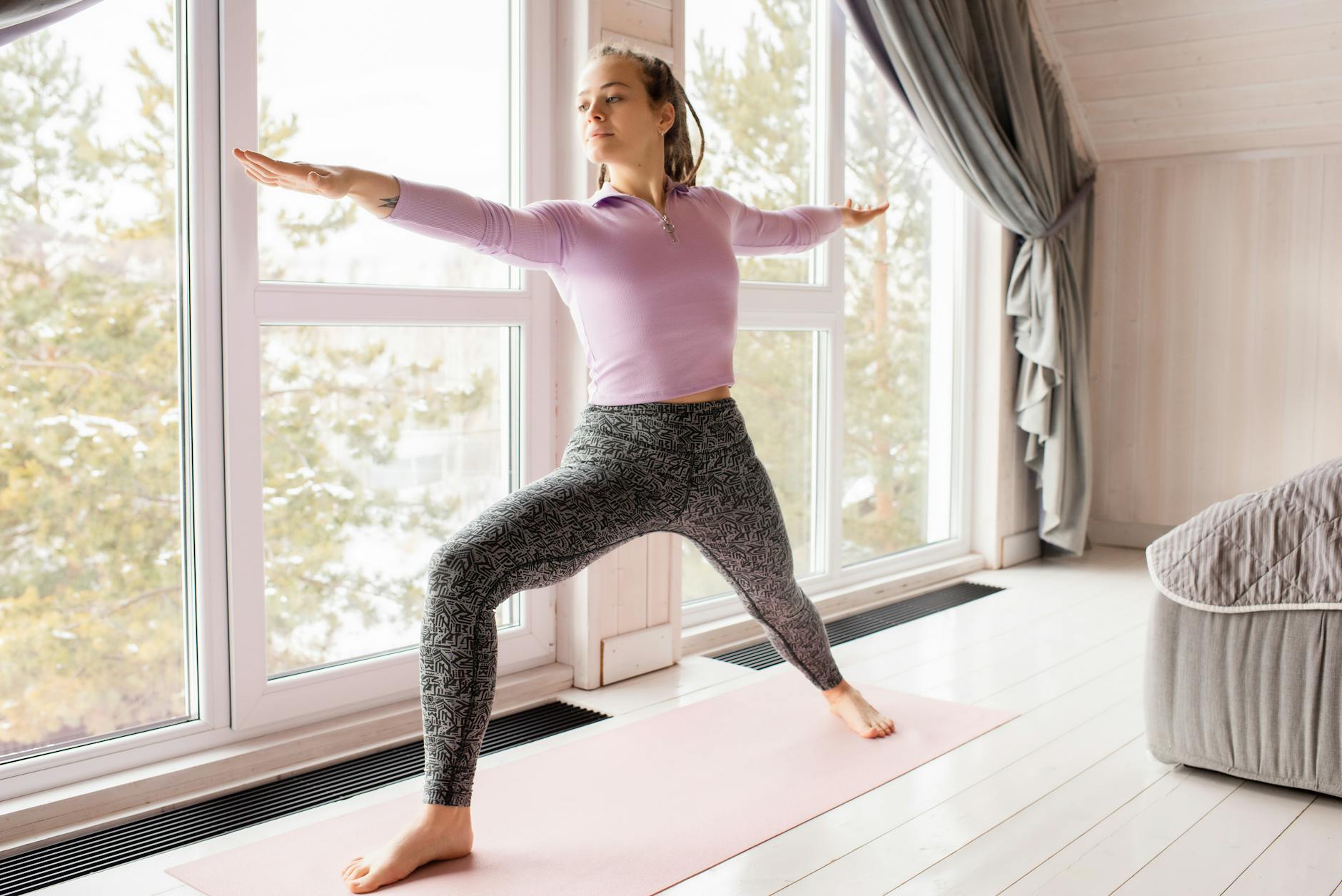
Now that we've covered strength training, let's focus on improving your flexibility and balance. These exercises are crucial for maintaining overall fitness and preventing injuries.
A. Standing toe touches
Start your flexibility routine with standing toe touches:
-
Stand with feet hip-width apart
-
Slowly bend forward, reaching for your toes
-
Hold for 15-30 seconds, feeling the stretch in your hamstrings
-
Slowly roll back up to the standing position
Repeat 3-5 times to improve hamstring flexibility and lower back mobility.
B. Cat-cow stretch
The cat-cow stretch is excellent for spinal flexibility:
-
Start on hands and knees in a tabletop position
-
Inhale, arch your back and look up (cow pose)
-
Exhale, round your spine, and tuck your chin (cat pose)
-
Repeat 5-10 times, moving with your breath
C. One-leg balance
Improve your balance with this simple yet effective exercise:
-
Stand near a wall or chair for support if needed
-
Lift one foot off the ground, balancing on the other
-
Hold for 30 seconds, then switch legs
-
Repeat 2-3 times on each leg
To increase difficulty, try closing your eyes or standing on an unstable surface.
D. Downward dog pose
Finish with the downward dog, a yoga pose that stretches multiple muscle groups:
-
Start on hands and knees
-
Lift your hips, straightening your arms and legs
-
Form an inverted V-shape with your body
-
Hold for 30-60 seconds, breathing deeply
| Exercise | Duration | Benefits |
|---|---|---|
| Standing toe touches | 15-30 seconds | Hamstring flexibility, lower back mobility |
| Cat-cow stretch | 5-10 repetitions | Spinal flexibility, core engagement |
| One-leg balance | 30 seconds per leg | Balance improvement, leg strength |
| Downward dog pose | 30-60 seconds | Full-body stretch, shoulder strength |
Incorporating these flexibility and balance exercises into your routine will complement your cardio and strength training, leading to a well-rounded fitness program. Next, we'll explore the importance of cooling down and stretching to complete your morning workout.
Starting a morning exercise routine at home is an excellent way for beginners to boost their health and energy levels. You can kickstart your day with improved physical and mental well-being by incorporating warm-ups, cardio, strength training, and flexibility exercises into your routine. Remember to cool down and stretch properly to maximize the benefits of your workout.
Consistency is key to seeing results from your morning exercise routine. Start small, gradually increase intensity, and stay committed to your goals. With the right equipment, proper technique, and a positive attitude, you can transform your mornings and set a foundation for a healthier lifestyle. Embrace the challenge, celebrate your progress, and enjoy the numerous benefits that come with making exercise a regular part of your morning routine.
Comments
Post a Comment